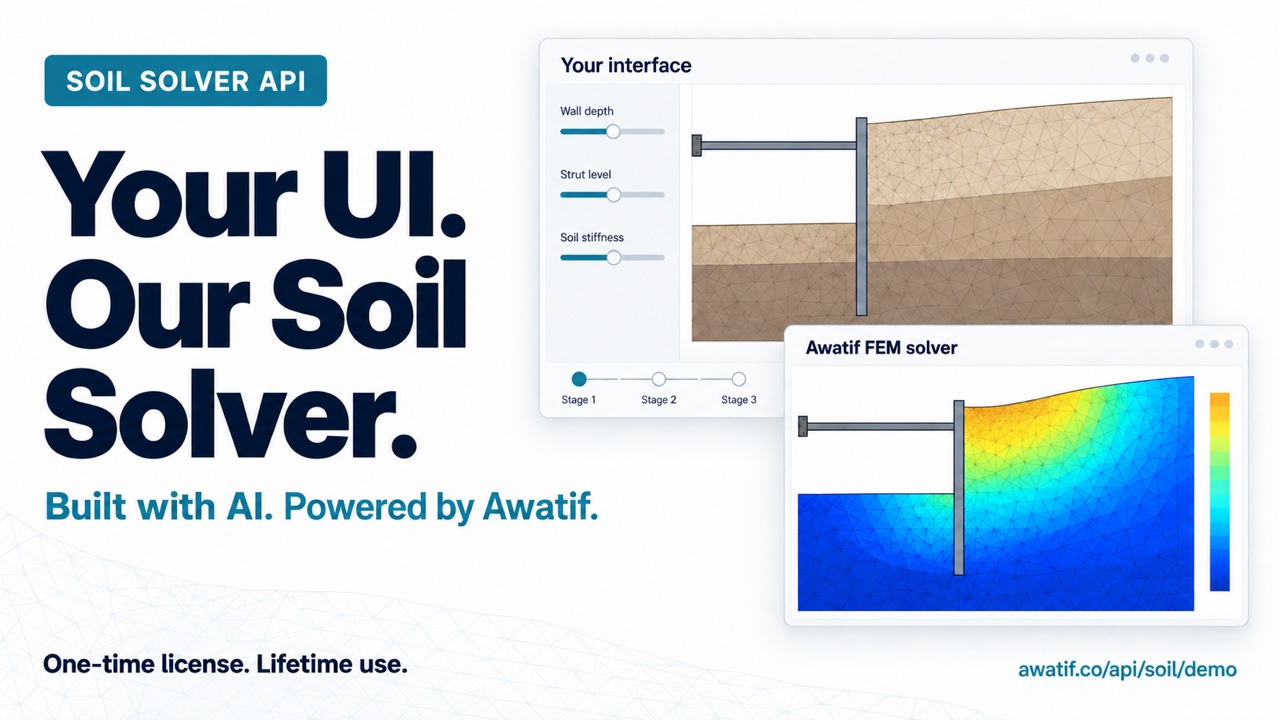
With an AI model like Claude, you can replace expensive tools such as Plaxis.
These models are extremely good at building user interfaces. The FEM engine behind such an app is not something AI replaces easily. Building a new solver from scratch takes a tremendous effort of validation and benchmarking. That is exactly the gap we are bridging with our solver.
Using our years of experience and research in building FEM solvers, before the era of AI, we are extending the capabilities to model soil behaviour: drained Mohr-Coulomb with tension cut-off, layered ground, groundwater, retaining walls, interfaces and struts, with staged construction throughout. The solver is cross-validated against OpenGeoSys and closed-form solutions. This way you can let the AI build your desired user interface without compromising the calculation accuracy, which is handled by our battle-tested API.
See a live example of such a UI, a staged excavation with a retaining wall, using our solver as the backend:
- Demo: awatif.co/api/soil/demo
- Benchmarks: awatif.co/api/soil/paper
Update, October 2026: the solver is no longer for sale. The demo and the paper stay online, and I now teach structural engineers to build AI agents that drive the tools they already use. Happy to answer any questions on LinkedIn or by email.