 Blog
Blog
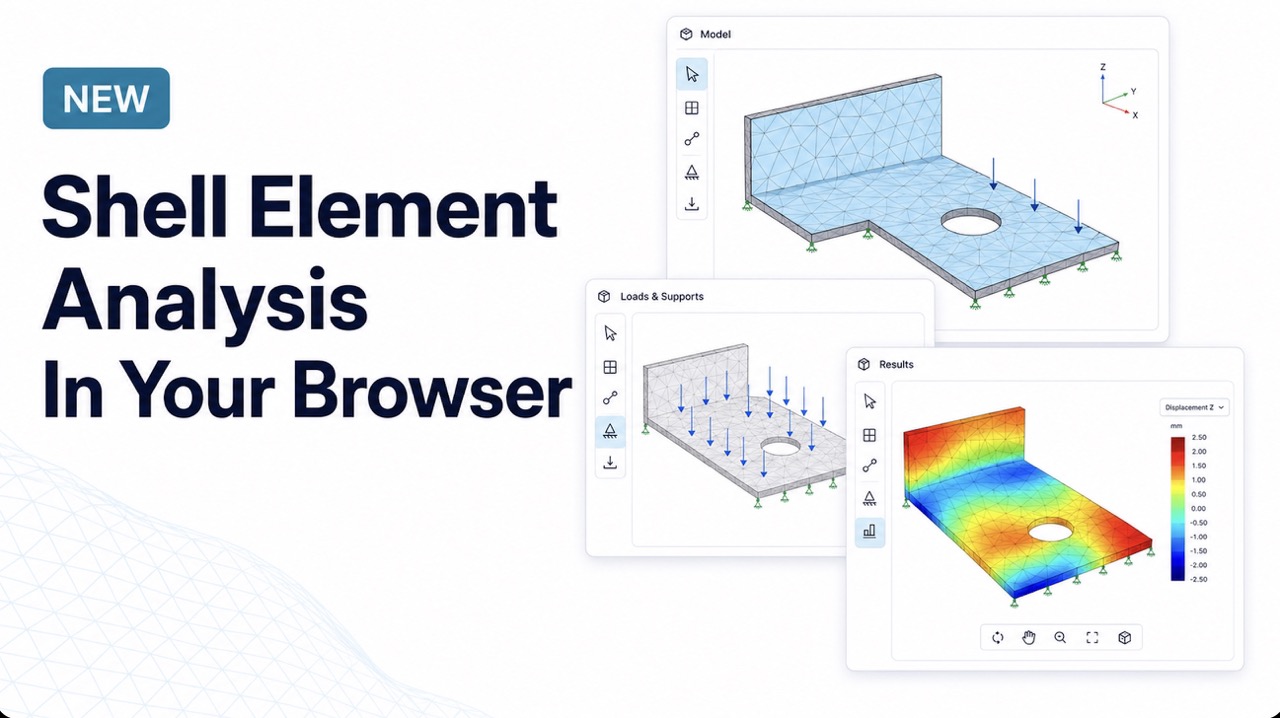
One of the most requested Awatif features is here.
You can now create, mesh, and analyse shell elements in real time, directly in your browser.
This expands Awatif beyond frame-based models and makes it possible to model structural components such as slabs, walls, plates, and connections—all within the same open-source workflow.
From Polygons to Analysis
Shell analysis often starts with a surface, but a solver needs a discrete finite element model.
Awatif now connects these steps in one workflow. You can:
- Create polygon geometry
- Generate triangular meshes
- Assign shell properties and loads
- Solve the model
- Inspect the structural response in the browser
Because the geometry, mesh, analysis, and visualisation are connected, changes to the model can be reflected immediately in the results. This makes shell behaviour easier to explore while the design is still moving.
Frame and Shell Elements in One Model
Real structures are rarely made from only beams or only surfaces.
A building may contain beams, columns, slabs, walls, and local plate connections. These elements need to work together, but modelling them in separate systems creates extra work and makes consistency harder to maintain.
Awatif can now solve frame and shell elements together in the same model. This opens the door to applications such as:
- Slab and wall analysis
- Plate and connection modelling
- Mixed beam-and-slab systems
- Interactive teaching tools
- Custom structural analysis applications
Built for Interactive Analysis
The solver uses Awatif’s high-performance C++ implementation, compiled to WebAssembly so it can run directly in the browser.
The shell implementation uses triangular elements and is based on the formulation presented by Rama, Marinkovic, and Zehn in their 2018 paper, High performance 3-node shell element for linear and geometrically nonlinear analysis of composite laminates.
Bringing the complete workflow into the browser removes the need for a desktop installation and makes it easier to build interactive engineering tools around the solver.
Free and Open Source
Like the rest of Awatif, shell-element analysis is completely open source under the MIT licence.
You can use it, inspect the implementation, modify it, and build your own engineering applications on top of it.
Huge credit goes to Musaab Mahjoub for developing this feature and making shell analysis possible in Awatif.
Try Shell Elements in Awatif
Live app: Try shell elements in Awatif
Source code: View the source code
Awatif is built with and for the structural engineering community. Try the new workflow, share your feedback, and help us make open engineering software better.