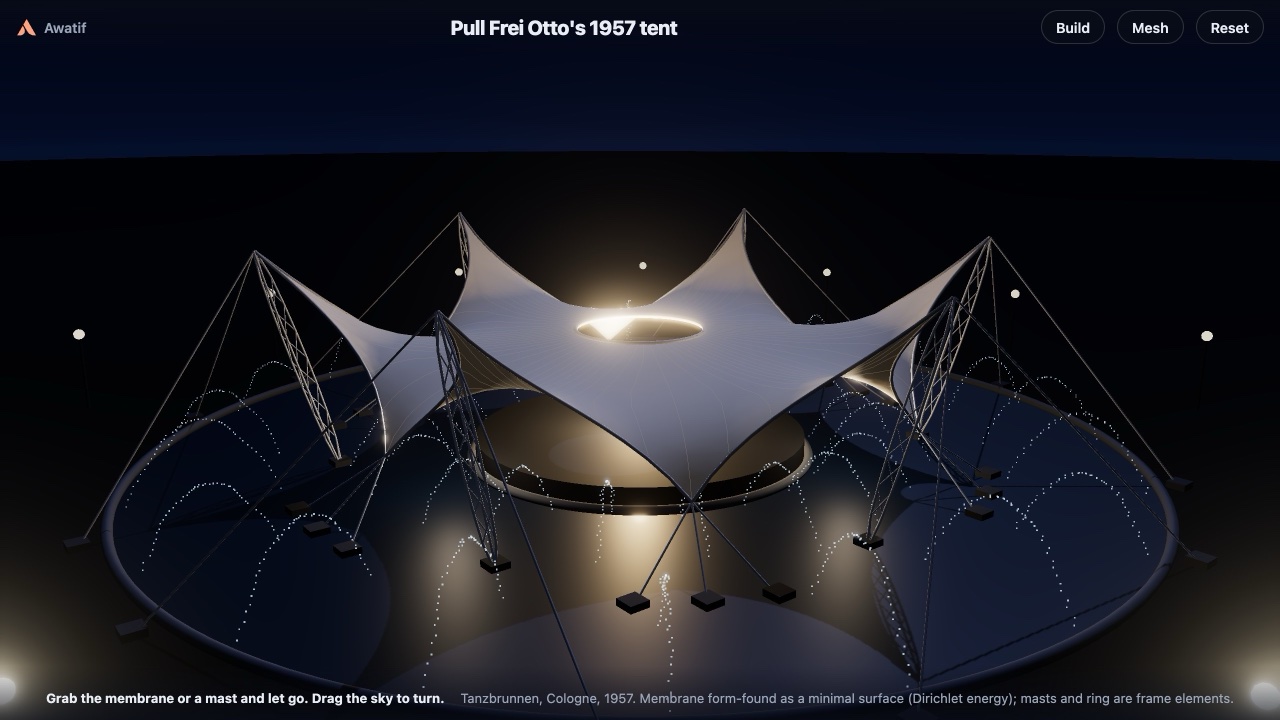
Frei Otto found this shape with soap film in 1957. Your browser finds it in 40 milliseconds.
It's his Tanzbrunnen tent in Cologne: six lattice masts, six tie-downs, a floating ring with a 6 m opening, and one membrane. Grab the fabric or a mast, pull, and let go. The tent bounces back with real dynamics, solved live, and settles after a swing or two.
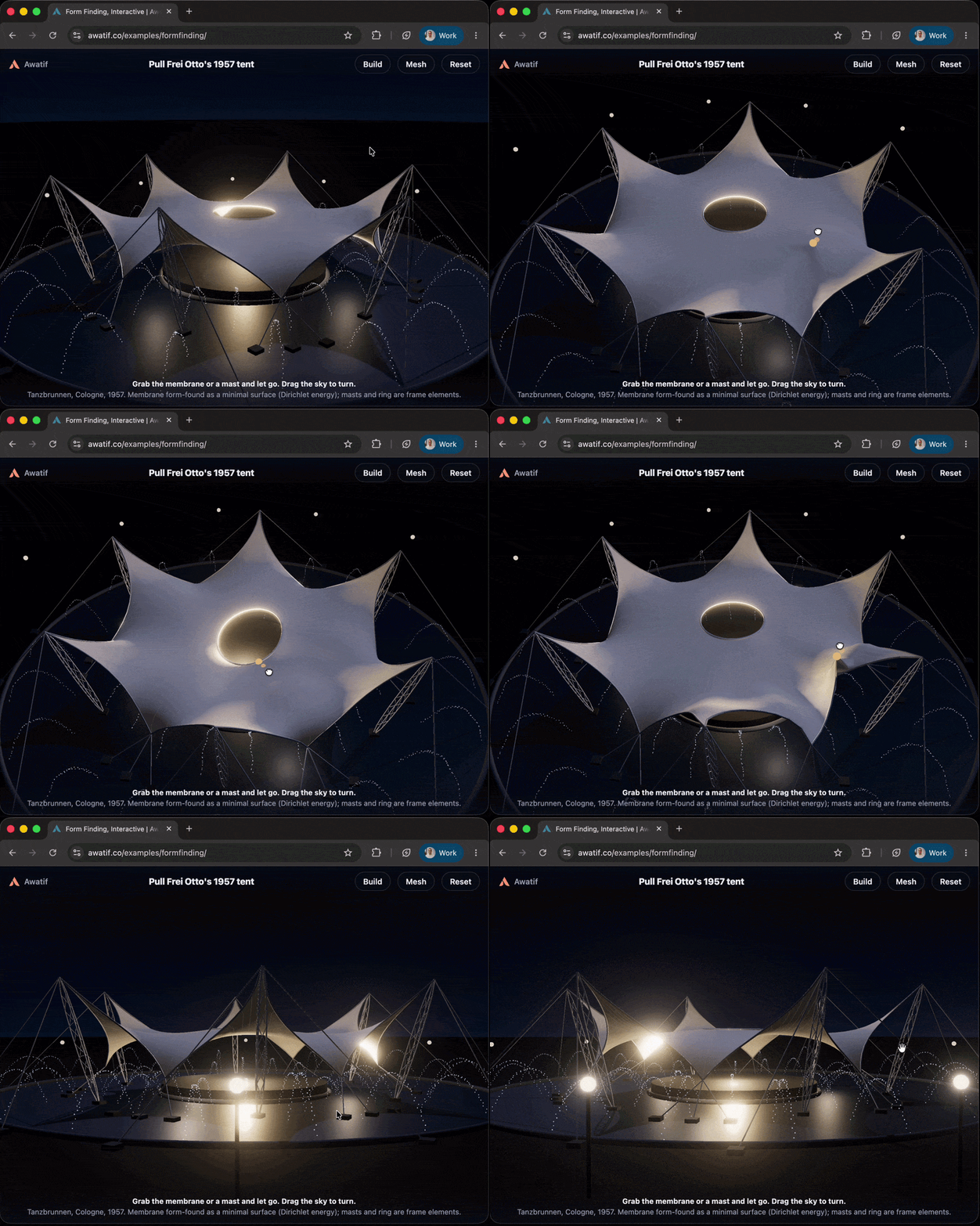
Play with it here: awatif.co/examples/formfinding
Watch it go up
The page opens on the build, one step at a time. First the soap film. Then the workshop, where the surface is cut into 72 strips, each flattened into its cutting pattern and cut 2% short. On site the membrane is unfolded and shackled to the masts lying on the stage, the masts are hoisted, and finally the low points are winched down until the ring lifts off the stage. You can pause, step back or skip.
Prestress and erection are where tensile structures get tricky, and they're the hardest part to picture from a drawing. Watching the fabric go from slack to taut makes it click. One honest note: the slack shapes in the animation are drawn, and how the 1957 tent was actually put up isn't documented. The last pull taut, and the bounce that follows, is solved.
How it works
- Form finding. The membrane is a soap film: the least-area surface spanned by the ring, the high and low points and the edge cables. Forty rounds of Pinkall–Polthier iteration, one sparse solve each, take about 40 ms.
- Stiffness. The prestress resists a change of shape, and the fabric resists stretch: orthotropic PVC-coated polyester, 600 kN/m along the warp, 450 kN/m along the fill and 15 kN/m in shear. Cables, guys and tie-downs are prestressed bars. The masts and the ring are 3D frames.
- Speed. About 7,800 degrees of freedom, factorised once. Each time step is one back-substitution, about 0.8 ms in the browser.
One thing to try
Pull the ring up. Why is it so much softer than the masts? Answers welcome on LinkedIn.
Where this is going
I built this with an AI agent. Intelligence got fast and cheap, so it pays to spend the computation before anyone goes to site: come up with the concept, see it, simulate it in real time, design it, then prepare the shop drawings, the construction sequence and the bill of quantities, all in one environment where your agent has every piece of data it needs. That's revolutionary, if you know what you want and you lead the development.
At Awatif, I teach structural engineers to turn their own workflows into AI agents. Happy to answer any questions on LinkedIn or by email.