
Making Earthquake Time-History Analysis Visible
I used to find earthquake time-history analysis hard to explain.
Not because the equations are impossible. Structural engineers can learn the equations. The difficult part is that the most important behavior is dynamic. It happens through motion, timing, stiffness, mass, and amplification.
When you show it as a static diagram, something gets lost. When you show it only as a response plot, something still gets lost. The structure is moving, but the explanation is frozen.
An Interactive Way To See It
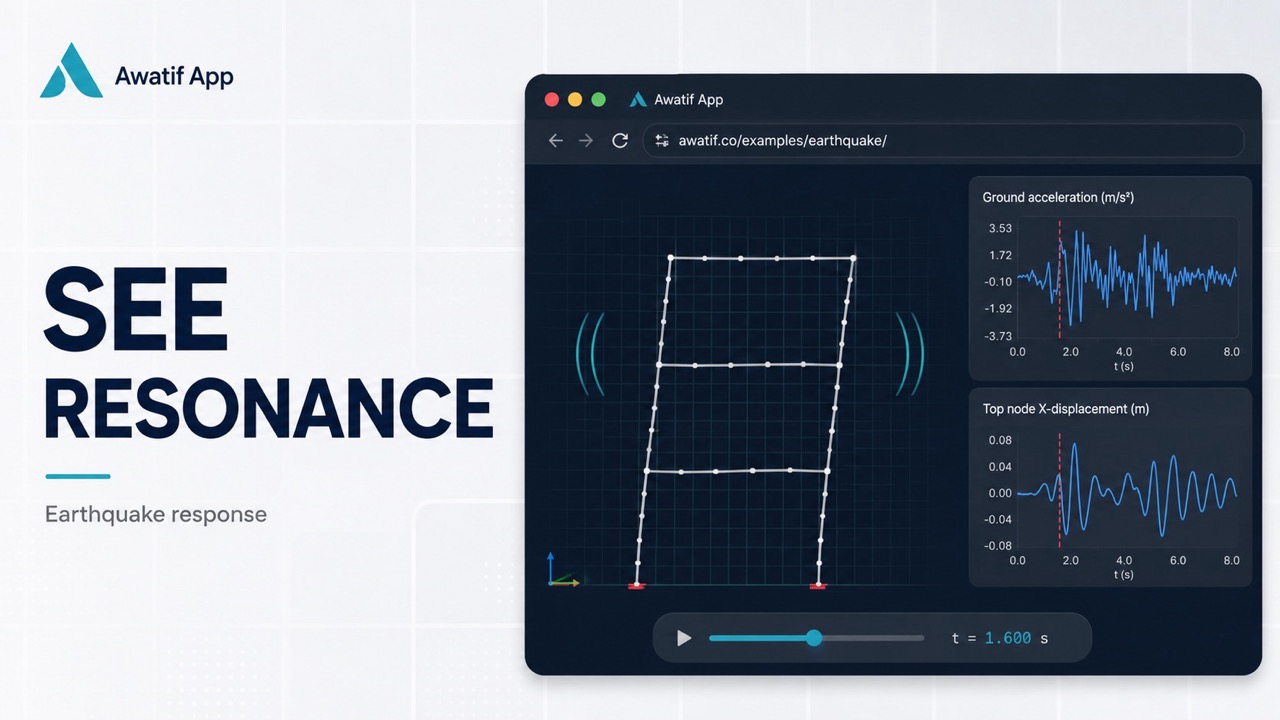
Then Kaison Cheung built an interactive Awatif app where you can change the frame stiffness and immediately see how the earthquake response changes.
The model is simple on purpose: a frame, mass sources, an earthquake acceleration record, and a moving deformed shape in the browser. That simplicity makes the idea easier to see.
Adjust the stiffness and the structure responds differently. Most changes behave the way you might expect. A stiffer frame usually moves less. A more flexible frame usually moves more.
But then there is a point where a small change in stiffness creates a huge increase in displacement.
That Jump Is Resonance
Resonance is often introduced as an equation, a frequency ratio, or a peak on a response spectrum. Those are useful, but they can make the phenomenon feel abstract.
In the app, resonance becomes visible. The earthquake input and the structure's natural response start to line up. Energy enters the structure at the wrong time, or the right time depending on your point of view, and the displacement grows much faster than intuition expects.
That is the moment I care about. The result is no longer just a number. It is a moving structure on the screen, showing why one stiffness value can feel safe while another nearby value suddenly becomes uncomfortable.
Why This Matters
Earthquake engineering is full of ideas like this. They are not only difficult because the math is advanced. They are difficult because engineers need to connect the math to physical intuition.
Interactive simulation helps close that gap. Instead of changing a parameter, running a separate analysis, exporting results, and rebuilding the mental picture afterward, the feedback happens immediately.
This is one of the directions we are exploring with Awatif: making structural behavior easier to test, explain, and reason about while the design is still moving.
Try The Demo
You can try the earthquake app here and change the frame stiffness yourself.
If your team is working on structural automation, simulation tools, or engineering workflows where this kind of immediate feedback would help, send me a message. I am always open to collaborations with people building better ways to understand and design structures.