 Blog
Blog
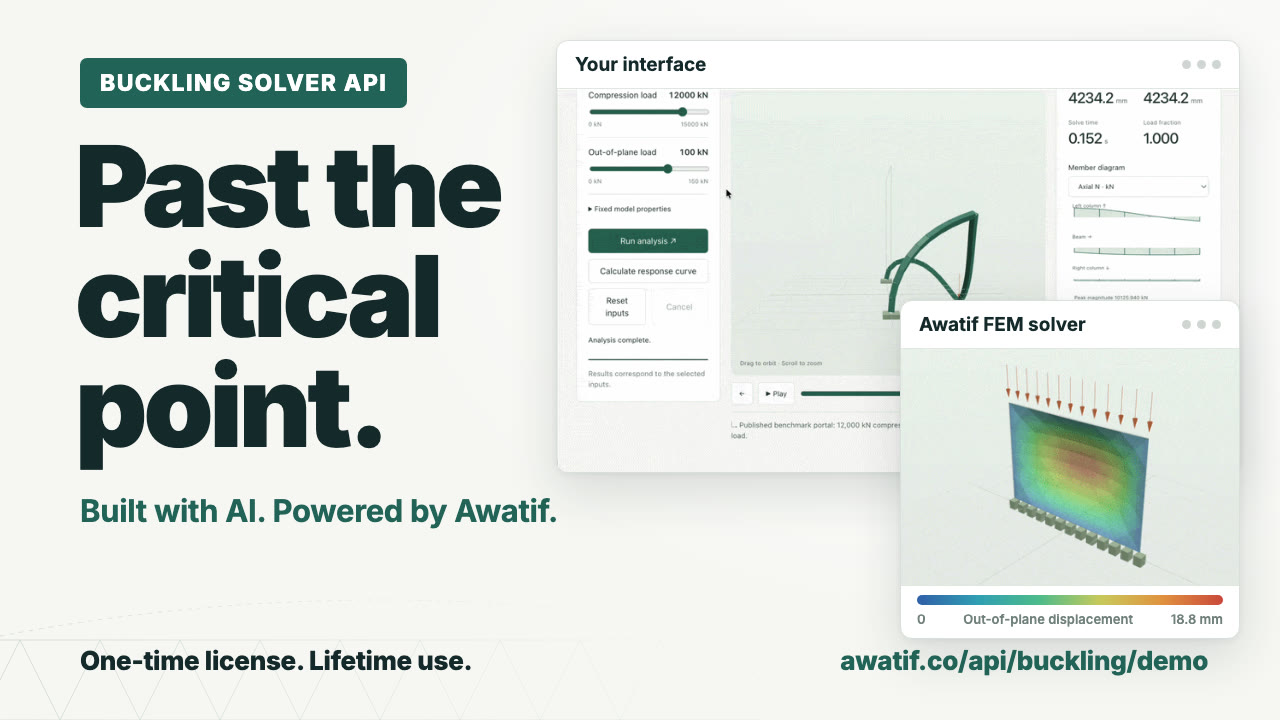
Turn on geometric nonlinearity (second-order effects) and you have probably hit the famous non-convergence error, then concluded the structure has buckled. That's true, but how did it buckle? Which member went first? Was it local or global buckling? Until now, that part stayed a mystery.
With our new solver you can see exactly what happens after buckling (post-buckling), quickly and robustly. Conventional solvers like Ansys and Abaqus trace the load path step by step, usually with a continuation method such as arc-length. In our benchmark against Abaqus, the same frames took nearly 295,000 equilibrium iterations. Ours needs no continuation: it resolves equilibrium directly and reached the same answer, within 1%, in 5 to 60 iterations.
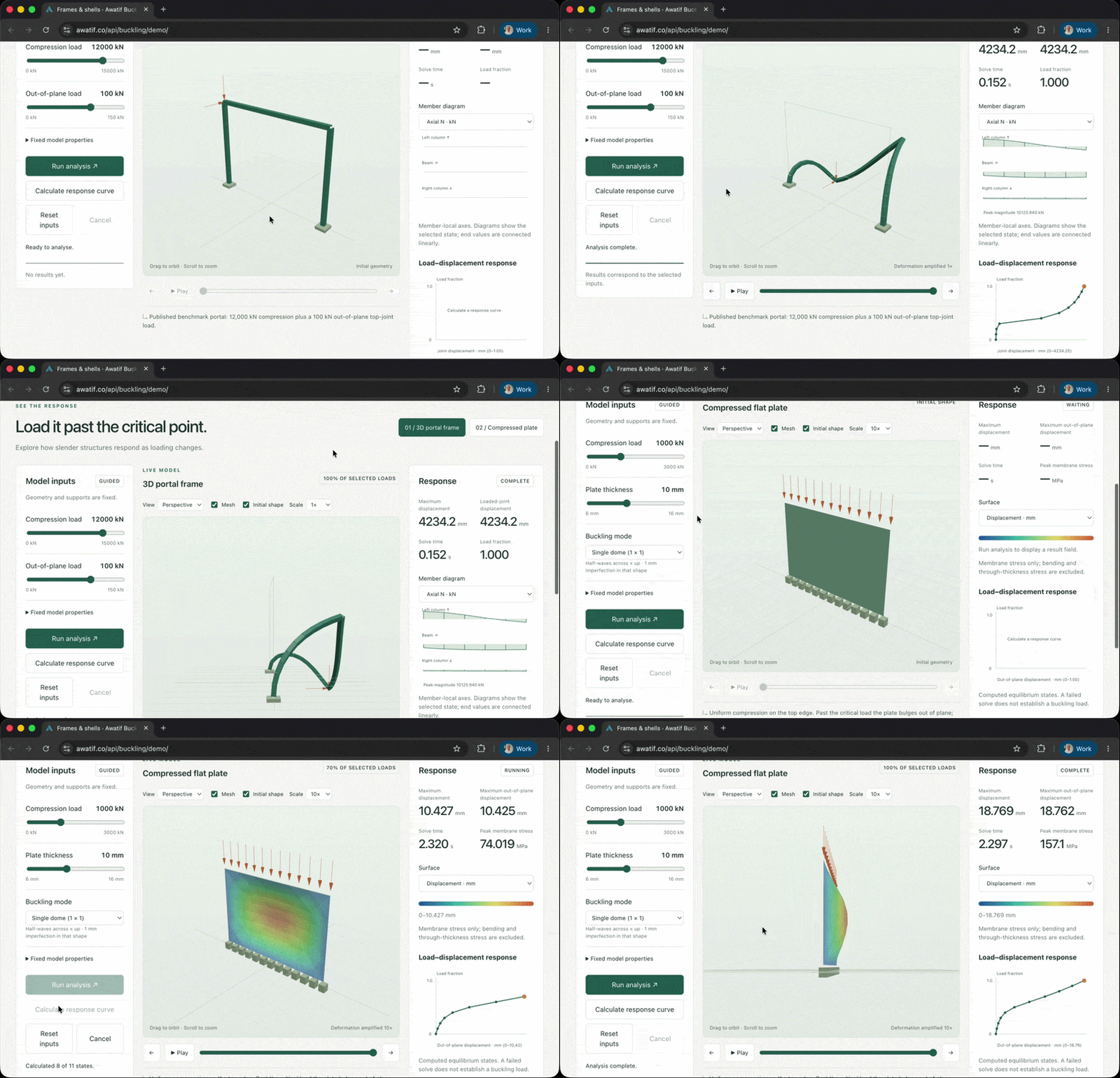
See it for yourself, and check the numbers:
- Demo: awatif.co/api/buckling/demo
- Paper: awatif.co/api/buckling/paper
Our business model is simple. You pay once for the solver and use it as your backend. Then you let AI build the user interface, like the one in the demo, in minutes. That way you can replace the analysis you run today in expensive licensed tools like SAP2000 or STAAD.Pro. Happy to answer any questions on LinkedIn or by email.